
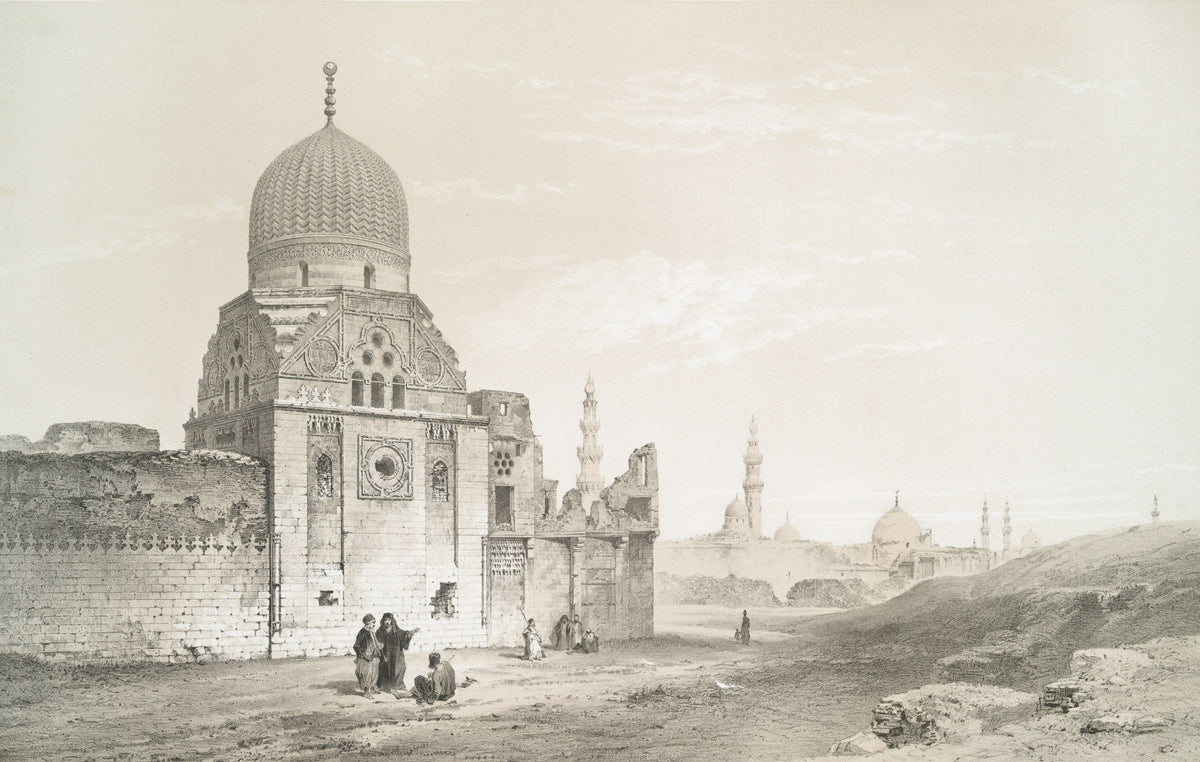
What No One Produces: The Islamic Authority Of Olfaction
Written by Adill Ali. Read time 14mins.
Abstract
The scent of an early Islamic sanctuary was an instrument of rule. Caliphs paid for the perfume that covered the Kaʿba and the Foundation Stone in Jerusalem, rival dynasties competed for the credit of having been first to provide it, and attendants controlled who might carry any of it away. A second claim on scent appears later in the sources, made by the mystical tradition, whose masters of olfaction were held to perceive through smell what other people could not, and whose perception was kept within the bond of a Sufi order. Read together, the two look like a shift in authority from the one who supplies a scent to the one who claims to perceive it. This essay argues that the shift is less clean than it looks, and that the reason lies in a position held within the same tradition. On al-Āmidī's occasionalism, the perception of a smell occurs by the power of God and in keeping with His custom, so that no creature brings the perceptual event into being. The caliph holds the material and its giving, which can be owned and administered. The saint may hold the permission to reach such a perception, the recognition of whoever claims it, and the reading of what it discloses. The event itself, on this account, is created by neither. The contest over sacred scent was therefore a contest over something that neither party to it made, and what each party held was narrower than what each claimed. The argument holds only if the occasionalist commitment holds, and the essay says so. It also leaves open a question that the commitment raises and does not settle: what to make of the share of the one who smells, and of the provisioner's share on the same terms.
· · ·
Twice a week the attendants of the Dome of the Rock prepared the chamber. They covered the whole of the Foundation Stone, the Ṣakhra (الصخرة), in a perfume compounded of musk, ambergris and saffron, and they walked its circuit carrying censers until the room stood full of scented smoke. Then the curtains were lifted and the smoke let out, and the space was opened. Visitors came in and prayed at the stone, and when they left the scent went with them, worked into their clothes and their skin. Days later a man could be known by it in the street. Here was someone who had been inside the Ṣakhra.1
That is the picture to hold, because everything in this essay turns on it. A scent was bought, applied and released, and a person carried it out of the building and was recognised by it elsewhere. Each of those steps was somebody's doing, and the question is whose.
The reports describing the rite were set down generations after the building went up in the 70s/690s, belonging at the earliest to the late Umayyad period and reaching their fullest form later still, in the geographers and in the compilers of the merits of Jerusalem. What they preserve, then, is the rite as later writers understood it rather than a record made at the time. The practice was real enough for jurists to argue about its consequences, which is the use made of it here.
The provision
Scenting a sanctuary was expensive, and the expense was the point. The caliph ʿAbd al-Malik, who built the Dome, provided rooms within the complex for making the perfume, and attendants funded from the khums to apply it to the Rock.2 Perfume of this kind was not a gesture. It was a standing provision, renewed, staffed and paid for out of a fixed source, and everyone in Jerusalem could smell where the money had gone.
Because provision was visible, it was worth claiming, and the sources show the claim being fought over. At the Kaʿba in Mecca one group of reports holds that Muʿāwiya was the first to perfume the House with khalūq (خلوق) and incense, setting aside for it a daily ration of perfume and sending scent for it in the pilgrimage season. Another group gives the precedence instead to his enemy ʿAbd Allāh b. al-Zubayr, the counter-caliph who held the Ḥijāz against the Umayyads and rebuilt the House, and who is said to have been the first to scent the building.3 Two rival houses cannot both have been first. What matters is that both wanted the title, and that the sources preserving their claims were partisan for one side or the other. To have been the first to perfume the sanctuary was a thing worth inventing a report about.
The authority in question here is worth naming plainly, because a later part of this argument depends on keeping it distinct from another kind. Provisioning a scent is a jurisdictional matter. It is the power to pay for a sacred place, to maintain it, to mark it and to say who may do so. Nothing in it concerns perception. A caliph who endows a perfume is doing what a caliph does with a road or a wall.
That the authority was jurisdictional shows most clearly in how the perfume was administered once it was on the building. The clearest evidence for that comes from the Kaʿba at Mecca rather than from Jerusalem, so what follows compares two sanctuaries rather than describing one. The perfume was treated as property, and access to it was controlled. The Meccan jurist ʿAṭāʾ b. Abī Rabāḥ held that a pilgrim might carry away some of the Kaʿba's perfume with the permission of the attendants, and in another version he put it as an instruction: do not rub perfume from the House unless it is given to you.4 Permission was required because the substance was administered, in the way that a building's fabric is administered.
A stricter view was available, though it rested on a different concern. Saʿīd b. Jubayr found it detestable that any of the Kaʿba's perfume should be carried off in order to seek healing with it, and when he saw an attendant doing so he would strike her.5 His objection belongs to a debate about taking sacred matter out of the Ḥaram rather than to the administration of property, so the administrative point rests on ʿAṭāʾ's rule and not on his.
Here is the material layer in plain form. A quantity of scented matter existed, it belonged to the sanctuary, and somebody decided who could have any of it.
The perception
The second claim on scent that appears in the sources is of a different kind, and the difference is the hinge of this essay. Where the caliph's claim concerned a substance, this one concerns an act of perceiving.
Ibn al-ʿArabī holds that the gift of perceiving what is ordinarily hidden belongs to all five senses and not to sight alone, so that a person may be a master of vision, or of hearing, or a master of breath and fragrances, which is to say a master of olfaction.6 Such a person smells what others in the room do not. Later writers took the idea up and hedged it with conditions. Bursavī, writing in Bursa around 1700, treats mystical olfaction as an actual bodily perception with bodily effects, and he restricts it: not everyone is granted it, and it stays within the master-disciple bond of the Sufi order, passed to those admitted to it.7
Both authors are cited here from Lange's reading of them rather than from the Futūḥāt and the Rūḥ al-bayān at first hand. That is a weaker footing than the theological passage set out below, which was read in the printed edition, and the difference is marked here rather than left for a reader to discover.
Set the two claims side by side and the difference is plain. The caliph's claim rests on a substance he can buy and control. The saint's claim rests on a perception that no purchase can secure, and it is an order rather than a treasury that controls admission to it and recognition of whoever claims it. Lange argues that the question of smell, and of who was able to perceive it, bore directly on who was granted authority in matters of religion, of science and of the sociopolitical order, and the material gathered here supports him. What is proposed here is narrower than his thesis and is not his.
Read together, the account Bursi gives of caliphal provisioning and the account Lange gives of mystical olfaction show two different pictures of the link between scent and authority: the authority of the one who supplies a scent, and the authority of the one who claims to perceive what others cannot. That is a comparison of two pictures, not evidence that authority passed from the first to the second. Establishing such a transfer would need evidence of displacement, of succession, or of one institution borrowing from another, and no such evidence is offered here. The comparison itself is a synthesis of the two studies rather than a claim either study makes in that form.
The custom
What complicates even that comparison comes from within the tradition itself, from a position taken by a theologian who was writing about how perception works.
The question put to al-Āmidī amounted to a choice among the accounts of how a smell reaches a nose, and he declined to choose. Whether perception comes about by a physical connection between the smell and the organ of smell, or by a transformation of the medium that carries it, the perception of a smell occurs, he held, only by the power of God and in accordance with His custom.8 He was applying to smell the account his school applied to everything else. Fire does not burn cotton by a power of its own; the burning occurs at the fire and not by it.
Put in the plainest terms, this is the claim: when a person smells something, the smelling happens because God makes it happen, in the regular way He has established, and neither the fragrant thing nor the nose nor the air brings it about by any power belonging to it. The regularity is real and can be relied upon. What it is not is a power possessed by any created thing.
Two levels need separating here, because running them together is the source of most objections to this argument. At the practical level there is someone who buys, someone who compounds, someone who distributes, someone who attends, someone who recognises and someone who interprets. At the theological level the question is what accounts for the creation of all those events. An act can be credited to the person who performs it at the first level without that person being its creator at the second. That holds for the caliph, the custodian, the perfumer and the perceiver alike, and not for one of them rather than another.
Now bring that back to the sanctuary, and the picture of the two claims changes.
Consider what the caliph held. He held a quantity of aromatic substance, and the money to buy more, and the staff to apply it, and the right to decide who could take any away. All of this is real, and all of it is material. He arranged the conditions under which people would smell something in that chamber. On the occasionalist account he did not create a single one of the perceptions that followed, because those occurred by a custom he neither established nor sustained. His authority reached the arrangement and stopped there.
Consider next what the saint claimed. He claimed to perceive what others in the same room did not, and his order claimed the right to say who might be admitted to such a perception, whose claim to it would be recognised, and what it meant. Admission and recognition are real things to hold, and an institution can hold them. But a perception that occurs by God's custom is received rather than created, and the one who receives it is not its creator. The order controls a threshold. Whether the perception occurs on the far side of it is not in the order's gift.
So the two claims fall on the same side of a line neither of them crosses. The caliph held the material and its giving. The saint may have held admission, recognition and the reading of what was disclosed. The creation of the perceptual event itself, which is the thing that made the scent worth having at all, belonged to neither.
This is a claim about creation and nothing wider. It does not say that the caliph had no authority, because he plainly did, over the substance and its distribution, nor that the saint's claim was empty, because admission, recognition and interpretation are genuine things to hold and to withhold. It does not deny either party's acts their social weight. The claim is narrower and firmer: the creation of the perception lay with neither party.
The share of the one who smells
One question remains open, and it sits at the point where this argument is thinnest.
The argument says that no creature creates the perceptual event. That conclusion follows from the occasionalist commitment, and it is worth being plain that it follows only from there. A reader who does not hold that commitment can accept everything else in this essay, the provision, the contest, the control of admission and recognition, and decline the conclusion. What survives such a refusal is the history, which is considerable: the scent of a sanctuary was paid for, administered and fought over, and a second claim to authority over scent arose later from another quarter entirely. Only the levelling conclusion depends on the theology. The essay does not establish occasionalism. It takes a position that al-Āmidī took, and it draws out what that position implies.
Within the commitment, a question presses from the other side first, and the division drawn above depends on how it is answered. Occasionalism does not stop at perception. If no created thing brings about an effect by a power of its own, then the caliph did not create the arrival of the perfume on the stone either, and the attendants did not create its compounding, so that the material arrangement is as much a sustained custom as the perception is. Occasionalism by itself therefore draws no line between the two parties. It covers them both.
The school's own instrument for the difficulty is acquisition (kasb, كسب), by which a person acquires an act without creating it, so that the provisioning is the caliph's in the way any act is a created agent's. But acquisition is discussed in relation to voluntary acts, and smelling is a perception that happens in a person rather than something he does by choice in the same way. Whether acquisition applies to it as it applies to an act, and on what grounds the two cases would differ, is a question this essay raises and does not settle. Answering it would need a textual treatment of kasb that this essay does not undertake.
A second question presses within the same commitment. The one who smells is not absent from the event. Something happens in that person and not in the person standing beside him who notices nothing. But an event can belong to a person without that person being its creator, and attention, inhalation, sensation and recognition are distinct things that one word should not be made to cover. Whether the perceiver's share reaches as far as creation, or whether he receives, attends and interprets without creating, is a question al-Āmidī's position raises without answering. The material examined here does not decide it, and this essay does not decide it either.
· · ·
Return to the man in the street with the scent of the sanctuary in his clothes. Everything that put it there can be traced to somebody. A caliph paid for the perfume, attendants compounded and applied it, a keeper decided what might be carried out of the chamber, and the man himself walked in and stood where the smoke was. Every one of those is an act, and every one of them has an owner.
The moment a passer-by catches the scent and knows where the man has been, the chain of acts runs out. That moment was arranged by many people and created by none of them.
A perfumer stands in the same position, and it is worth saying so plainly, because the temptation to claim more is strong and the practice does not support it. What a perfumer makes is a material and a set of conditions: this in the bottle, at this strength, to be worn on skin, in this air, by a person who will meet it in a moment nobody present can foresee. That is a great deal to arrange, and arranging it well is the whole of the craft. The moment when someone smells it and something happens in them belongs to a different order. It is the thing the work is for, and it is not the thing the work creates.
Notes
- al-Wāsiṭī, Faḍāʾil al-bayt al-muqaddas, 82–83 no. 136; Ibn al-Murajjā, Faḍāʾil bayt al-maqdis, 59–60 no. 47; on the dating see Kister 1981, 185–186, and Elad 1995, 17–22, all cited in Bursi 2020, 201 ↩
- Bursi 2020, 206, drawing on Elad 1995, 51–56, Raby 1999, 167–173, and Kaplony 2002, 228, 324–326 ↩
- for Muʿāwiya, al-Azraqī, Akhbār Makka, 358 no. 291, and 357 no. 288 for the daily ration; for Ibn al-Zubayr, al-Fākihī, Akhbār Makka, III, 221 nos. 2008–2009, and al-Yaʿqūbī, Taʾrīkh, II, 311, all cited in Bursi 2020, 207 ↩
- al-Fākihī, Akhbār Makka, I, 348 no. 716, and Ibn Abī Shayba, al-Muṣannaf, V, 312 no. 14094, cited in Bursi 2020, 219–220 ↩
- Ibn Abī Shayba, al-Muṣannaf, V, 312 no. 14093, cited in Bursi 2020, 219 ↩
- Ibn al-ʿArabī, al-Futūḥāt al-Makkiyya, I, 639–640, cited in Lange 2025, 189 ↩
- Bursavī, Rūḥ al-bayān, IV, 333–334, cited in Lange 2025, 187–188, with Lange's own comment at 200 ↩
- al-Āmidī, Abkār al-afkār, I, 489 ↩
References
A note on sources. Al-Āmidī's Abkār al-afkār was read in the edition listed below. Every other primary source cited here was consulted in the citations given by Bursi (2020) and Lange (2025) rather than in the editions themselves, and is marked accordingly, with the edition details as those studies record them. Secondary works named in the text are listed separately.
Primary sources cited through Bursi (2020)
al-Azraqī, Abū l-Walīd Muḥammad. Akhbār Makka wa-mā jāʾa fīhā min al-āthār. Edited by ʿAbd al-Malik b. ʿAbd Allāh b. Duhaysh. Mecca: Maktabat al-Asadī, 2003.
al-Fākihī, Abū ʿAbd Allāh Muḥammad. Akhbār Makka fī qadīm al-dahr wa-ḥadīthihi. Edited by ʿAbd al-Malik b. ʿAbd Allāh b. Duhaysh. 2nd ed. Beirut: Dār Khiḍr, 1994.
Ibn Abī Shayba, Abū Bakr. al-Muṣannaf. Edited by Abū Muḥammad Usāma b. Ibrāhīm b. Muḥammad. Cairo: al-Fārūq al-ḥadītha, 2008.
Ibn al-Murajjā, Abū l-Maʿālī al-Musharraf al-Maqdisī. Faḍāʾil bayt al-maqdis wa-l-khalīl wa-faḍāʾil al-Shām. Edited by Ofer Livne-Kafri. Shafā ʿAmr: Dār al-mashriq, 1995.
al-Wāsiṭī, Abū Bakr Muḥammad b. Aḥmad. Faḍāʾil al-bayt al-muqaddas. Edited by Isaac Hasson. Jerusalem: Magness Press, 1979.
al-Yaʿqūbī, Ibn Wāḍiḥ. Taʾrīkh. Edited by Martijn T. Houtsma. Leiden: Brill, 1883.
Primary sources cited through Lange (2025)
Bursavī, Ismāʿīl Ḥaqqī. Rūḥ al-bayān. Edited by ʿAbd al-Laṭīf Ḥasan ʿAbd al-Raḥmān. 10 vols. 2nd ed. Beirut: Dār al-kutub al-ʿilmiyya, 1430/2009.
Ibn al-ʿArabī, Muḥyī al-Dīn Muḥammad. al-Futūḥāt al-Makkiyya. Edited by ʿAbd al-ʿAzīz Sulṭān al-Manṣūb. 12 vols. Cairo: al-Majlis al-Aʿlā li-l-Thaqāfa, 1431/2010.
Primary source consulted directly
al-Āmidī, Sayf al-Dīn. Abkār al-afkār fī uṣūl al-dīn. Edited by Aḥmad Muḥammad Mahdī. 5 vols. Cairo: Dār al-Kutub, 1423/[2002–3].
Secondary sources
Bursi, Adam. 2020. "Scents of Space: Early Islamic Pilgrimage, Perfume, and Paradise." Arabica 67 (2–3): 200–234.
Elad, Amikam. 1995. Medieval Jerusalem and Islamic Worship: Holy Places, Ceremonies, Pilgrimage. Leiden: Brill.
Kaplony, Andreas. 2002. The Ḥaram of Jerusalem 324–1099: Temple, Friday Mosque, Area of Spiritual Power. Stuttgart: Franz Steiner.
Kister, Meir Jacob. 1981. "A Comment on the Antiquity of Traditions Praising Jerusalem." The Jerusalem Cathedra 1: 185–186.
Lange, Christian. 2025. "Thinking Through Smell: Theories of Olfaction in Early Modern Ottoman and Islamic Culture." Der Islam 102 (1): 168–210. https://doi.org/10.1515/islam-2025-0006.
Raby, Julian. 1999. "In Vitro Veritas: Glass Pilgrim Vessels from 7th-Century Jerusalem." In Bayt al-Maqdis: Jerusalem and Early Islam, edited by Jeremy Johns, 113–190. Oxford: Oxford University Press.

1 comment
Well done, very informative and interesting
Khaled Tubaileh
Leave a comment
This site is protected by hCaptcha and the hCaptcha Privacy Policy and Terms of Service apply.