
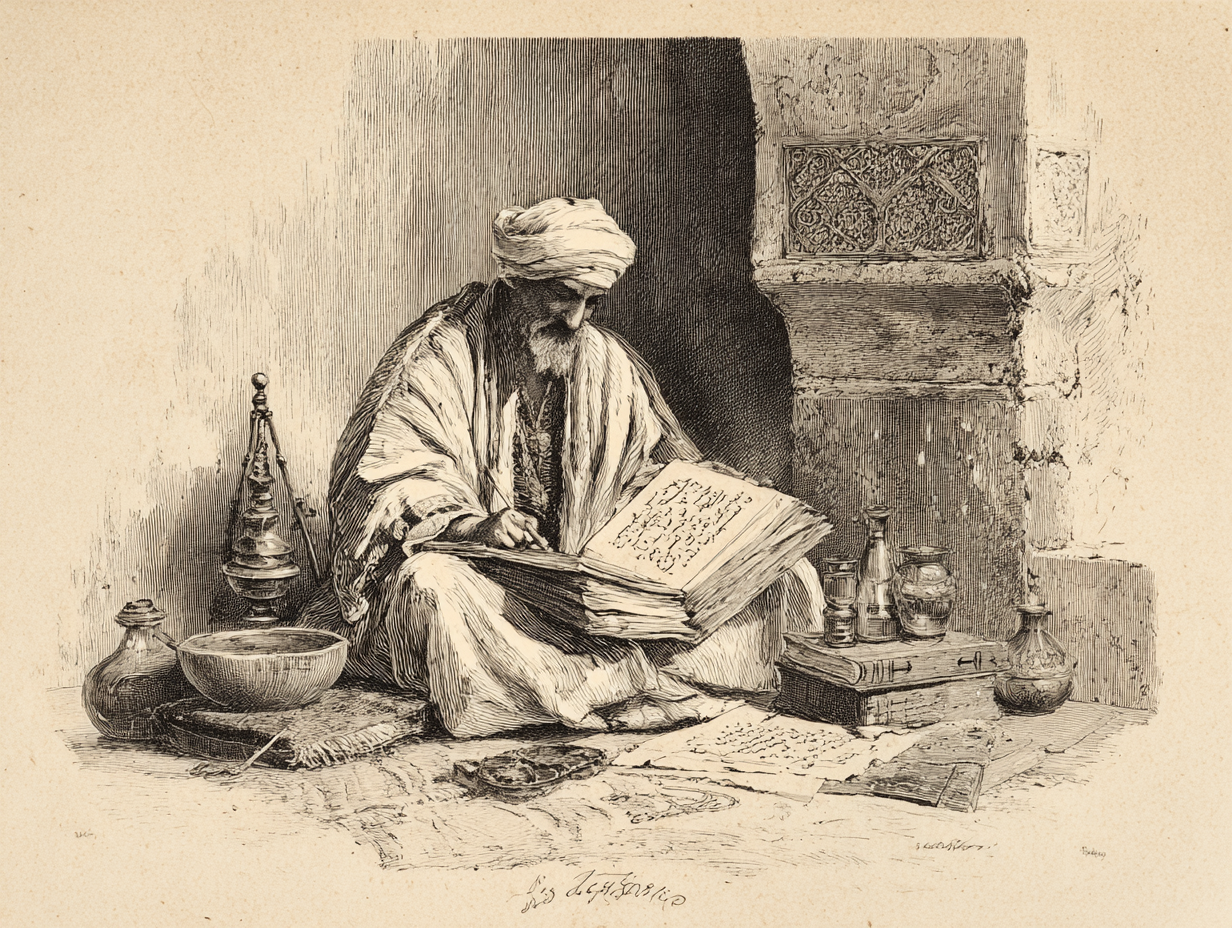
Ibn al-Jazzār & the Ignorant Perfumer
Oud & The Sacred Smoke I
Written by Adill Ali. Read time 15mins.
In a dispensary in Qayrawan, in the last decades of the tenth century, a physician set down a complaint about the people who sold perfume. He had spent a working life compounding aromatic medicines, weighing hot against cold, and he had watched the trade in those same materials go on around him in the markets of the city. What he wrote was not a remark about taste. It was closer to a charge of lethal negligence. The perfumers, he said, were the most ignorant of people about these things, and the most corrupting to health, because they confronted the hot with the hot and the cold with the cold, and so destroyed people by means they did not understand.
The physician was Abū Jaʿfar Aḥmad b. Ibrāhīm Ibn al-Jazzār, who died in 979 or 980. The sentence sits in his book on perfumery, a working manual rather than a polemic, between a recipe and a list of aromatic foundations. It is one of the clearest statements in the early Arabic record of a problem that has not left the trade in aromatic materials since: that the people who sell a substance are not, as a rule, the people who understand it, and that the distance between the two does harm.
This is the first of a series. The series moves toward a larger question, about what is owed to a material that enters the body, and that, carried as smoke, enters worship. The sacred use of smoke comes later. First comes the older problem, which is a problem of knowledge: who holds it, who lacks it, and what happens in the space between. Here there is only Qayrawan, a physician, and a line about perfumers that turns out, on inspection, to be a diagnosis.
THE PHYSICIAN AND HIS CITY
Ibn al-Jazzār was born into a family of doctors and lived his whole life in Qayrawan, in what is now Tunisia. He kept a clinic and a dispensary, and the later biographical tradition remembers him as austere, charitable, and unusually scrupulous, a man who treated both rich and poor and withdrew each year for a religious retreat. How much of that portrait is fact and how much is the piety that medieval biography liked to confer on its subjects cannot now be separated. What matters for the perfume book is narrower and more certain: he was a practising clinician who spent his days administering natural substances to bodies, and who therefore knew, in a way a merchant did not, what those substances did once they were inside a person.
The tenth century was Qayrawan's height. The city was the intellectual centre of Ifrīqiya, a meeting point of the Arab East, Berber North Africa, and the trade of the Mediterranean. Its physicians worked inside a medical tradition that had reached them across two centuries of translation, Greek into Syriac and Syriac into Arabic, and had been absorbed, argued with, and made their own. Ibn al-Jazzār was among the most widely read of them. His handbook for travellers, the Zād al-musāfir, was carried north to Salerno, rendered into Latin, and taught in the medical schools of Christian Europe for centuries under the name Viaticum. The man Latin medical Europe would come to know as Algizar was, in his own city, a clinician who also wrote about scent.
That he wrote about scent at all is the first thing worth pausing on. His book is the Kitāb fī funūn al-ṭīb wa-l-ʿiṭr, the book on the arts of perfume and aromatics. Most of it is a formulary: recipes for scented oils, distilled waters, powders for clothing, and incense. But it is a physician's formulary, and the recipes are not separable from the medicine that governs them. To Ibn al-Jazzār the question of which perfume to make and the question of how to treat a particular patient were the same kind of question, answered out of the same body of knowledge. The perfumer was not a figure standing beside medicine. He was working, whether he understood it or not, inside it.
This is what lifts the complaint above professional disdain. Ibn al-Jazzār is not saying that perfumers have poor taste, or that they cheat their customers on the scales. He is saying that they are practising medicine without knowing that they are, and practising it badly, on people who have no idea they are being treated at all.
WHAT THE WRONG PERFUME DID
To see why the charge was so severe, one has to enter the framework Ibn al-Jazzār took for granted, because inside it the wrong perfume was not a disappointment. It was an injury.
Islamicate medicine, like the Galenic medicine from which it descended, rested on the humours. Two pairs of opposing qualities, hot and cold, dry and moist, composed every body, every illness, and every material drawn from the natural world. Health was balance. Illness was an excess pulled in one direction. Treatment proceeded by the contrary, on the principle that an opposite remedies its opposite: a fever, hot and dry, met with the cold and the moist; a chill met with heat. The physician's task was to know where a body sat along those axes, where an illness was pulling it, and which material would pull it back.
Aromatics were not exempt from this scheme. They were among the most potent instruments the physician had. Most were reckoned hot and dry, which made them useful against the cold and moist illnesses and dangerous to anyone already hot. Musk was hot and dry; Ibn al-Jazzār places it in the second degree of heat and the third of dryness. Ambergris was hot. So was aloeswood, and so was saffron. Against them stood the cold aromatics: camphor, coldest of all, with sandalwood, rose, and oakmoss. A perfume was a compound of such materials, and a compound carried a temperament as surely as a patient did.
Ibn al-Jazzār set this out without ornament. The well-made perfume, he wrote, is the work of one who knows the potencies of the materials, the temperaments of bodies, and the susceptibility of the particular person in front of him. Made by such a person, the perfume is beneficial to the brain, the heart, and the liver, the chief organs whose health lengthens a life; it delights the soul and strengthens the whole body. The verb he chose for that delight was yuṭayyiba, from a root worth returning to later. The point for now is that the benefit was medical, and conditional. It depended entirely on a match between the material and the body that received it.
Knowing the temperament of a material was therefore not connoisseurship. It was dosage. A perfume of hot aromatics given to an aged person of cold humour in winter was medicine; the same perfume given to a hot-blooded youth in summer was harm. Ibn al-Jazzār says it plainly. Hot oils, he writes, benefit the aged and suit cold weather; cold oils agree with the young and the hot-tempered. Get the temperament wrong and one has not merely failed to help. One has administered the opposite of the cure.
The mechanism behind this was not a figure of speech, because in Ibn al-Jazzār's account scent was not an impression but a substance. It arose, he wrote, from a vapour disintegrating off the odorous body and travelling on the surrounding air, in through the nostrils, to the brain, where a pneuma in the forepart of the brain, the animating spirit responsible for sensation, motion, and thought, received it. He offered a clinical proof of the route. Someone whose nose is blocked by a cold cannot smell, because the vapour cannot reach the brain; clear the obstructed channel and the scent returns. The aromatic, on being inhaled, was taken into the body itself. Its potencies travelled with the air to the heart, and from the heart, with the animating spirit, to the brain. The perfume entered. It acted on the organs that govern life.
If scent is a substance that enters the body and works on its governing organs, then the wrong scent is not a question of preference. It is a substance acting wrongly, inside a person, on the parts that keep that person alive. This is why a sober clinician could write that the ignorant perfumer destroys people, and mean it as a clinician means it, not as a moralist reaching for a strong word.
WHAT THE PHYSICIANS SAW
The harm was not, to these physicians, a theoretical possibility. They had watched it happen, and at least one of them was willing to describe it.
A generation before Ibn al-Jazzār, in the Persian east rather than North Africa, the physician Abū Zayd al-Balkhī had written about the effects of odorous substances in terms that leave little to the imagination. A drug can act on body and soul through its odour alone, he observed: it may daze a person who smells it, confuse him, give him a headache, or kill him. The danger sat in the temperament. He named the mismatches directly, the reaction of a hot-tempered person to ghāliya, the compound unguent of musk and ambergris, and of a cold-tempered person to camphor. And he warned of a slower ruin. One who continuously breathes and sprays such perfumes, al-Balkhī wrote, is bound to suffer lasting damage to the brain and the bodily faculties. The wrong material, taken in often enough, wore the body down.
There is a detail in al-Balkhī's account that turns the whole problem back on the trade itself. The clearest victims of overexposure to aromatics, he noticed, were the perfumers. Their senses are so overpowered by the scents they work among that scarcely one of them can smell anything at all. He set them beside the tanners, who grow so used to the stench of their workshops that the foulness no longer reaches them. The comparison is exact and unsparing. The perfumer, drowned in his own materials, has lost the one sense by which he might have judged them. The person selling the substance can no longer perceive it. The ignorance Ibn al-Jazzār named was not only a gap in training. In the worst cases it was written into the seller's own body, a numbness earned at the counter.
Ibn al-Jazzār, for his part, claimed cases of his own and then withheld them. After the sentence on the perfumers he adds, in a single aside: if I were to narrate some of these things that I have witnessed and seen, it would prolong the book. It is a small line, and easy to pass over, but it changes the standing of everything around it. He is not reasoning about what could happen in principle. He is reporting, from a clinic where the harmed presumably came to be treated, that it does happen, and often enough that the telling would run long. He chose not to fill his perfume manual with the casualties of the perfume trade. The choice is itself a kind of testimony. He says the cases were there. He simply declined to count them out.
THE DIAGNOSIS
The complaint falls at a precise point in the book. Ibn al-Jazzār has just laid out the foundations of all perfume, the four hot aromatics and the four cold, and explained that the materials lying between them are safe only when entrusted to one who knows the combinations of bodies, the natures of people, and the potencies of the aromatic. Then, without softening:
As for the perfumers, they are the people most ignorant about these things as well as most corrupting for the health! For they may confront the hot with the hot and the cold with the cold, and thus destroy people by means that they do not understand.
The word that carries the charge is the one rendered as ignorant. In Arabic it is the privative of the person who possesses ʿilm, systematic and transmissible knowledge. The perfumer is not stupid, and he is not careless in the ordinary sense. He is operating without the body of knowledge his materials require, and, crucially, he does not know that he lacks it. That last clause is the whole of the accusation. The perfumer cannot perceive the harm he does, because perceiving it would require the very knowledge he does not have. He confronts the hot with the hot and sees nothing wrong, because nothing in his training has told him what there is to see. His ignorance is not only of the materials. It is of his own ignorance, which is the harder kind to cure.
And this is a diagnosis, not only of the perfumer but of a structure. The knowledge needed to use these materials safely existed; Ibn al-Jazzār was holding it as he wrote. The difficulty was that the knowledge lived with the physician while the materials lived with the trade, and the two had come apart. The perfumer had the substances and not the knowledge. The physician had the knowledge and not the counter. The buyer, standing in the shop, had neither, and no means of telling whether the person selling to him did. Three parties, and the one thing that would have made the transaction safe was distributed so that no single party to it held enough.
Ibn al-Jazzār did not invent this complaint. He inherited it. Eight centuries earlier Galen had said much the same of the medically ignorant compounders of his own day, and the descent of the idea is recorded in the very passage where the modern reader meets Ibn al-Jazzār's version. The gap between trade and knowledge was old before Qayrawan, and Ibn al-Jazzār is a point on a long line rather than its source. This is worth stating plainly, because the arresting fact is not that one physician noticed the problem. It is that the problem was already ancient when he noticed it, and that it has outlived him by a further thousand years without being solved.
THE BUYER WHO CANNOT KNOW
There is a deeper turn in Ibn al-Jazzār's account, and it concerns the one who buys rather than the one who sells.
Smell, he observed, is unlike the other senses in a particular respect. Sight perceives black and white and the gradations between them. Taste perceives sweet and bitter and the long range that lies between. Smell does not work this way. Following Galen, Ibn al-Jazzār allowed three categories of odour in principle, the good, the foul, and that which is neither; but he argued that the human nose cannot in practice resolve the middle the way the eye resolves grey or the tongue the half-sweet. The sense is too weak to hold the intermediate. And so, he concluded, in practice we say only this is a good scent and this is a foul one.
Consider what that leaves to the person standing in the shop. By the physician's own account, the buyer has two unaided judgements available: this pleases me, or this does not. From smelling alone one cannot say what the material is, where it came from, what temperament it carries, or whether it is the right material for one's own body. The knowledge that would answer those questions is not available to the ordinary nose. It lives in the head of someone who has studied; and that someone, as a rule, is not the person across the counter.
This is the asymmetry at its root, and it is worth being exact about why it is so stubborn. It is not merely that the seller knows more than the buyer, the ordinary condition of any trade. It is that the material itself withholds what matters. The ordinary buyer cannot reliably smell provenance. One cannot smell a temperament. A trained specialist may infer a great deal from scent, and the best of them can infer a surprising amount; but the unaided buyer, equipped with two words, cannot. The nose reports pleasure and displeasure and then falls silent. Everything that bears on using the material safely, and, in a trade, everything that bears on knowing whether one has been sold what one was promised, lies outside the reach of the only sense the buyer can bring to the encounter. The distance between commerce and knowledge is not, at bottom, a matter of dishonest sellers. It is built into what a scent can and cannot tell the person smelling it.
WHY OUD
Among the four hot foundations Ibn al-Jazzār names is the material this series will follow: aloeswood, or oud, set in his list beside musk, ambergris, and saffron, one of the pillars on which all perfume is built. He does not single it out as the most dangerous of the four. That is not his claim, and it should not be smuggled into his mouth. The claim is the present writer's, and it is this: of the materials Ibn al-Jazzār names, oud is the one in which his diagnosis becomes most visible.
The reason lies in the kind of thing oud is. Musk, ambergris, and saffron carry their own long histories of grading, substitution, and fraud; Ibn al-Jazzār himself warns that musk is constantly adulterated, and omits the methods from his book lest an unscrupulous reader learn them. But oud presents a difficulty of a different order. Its value lies inside variation itself: species, region, the manner of infection, the formation of the resin over years or decades, age, density, handling, and cut. It is the resinous heartwood of a tree that has been wounded and has defended itself, formed slowly and unevenly, indistinguishable in its raw state to anyone without long training, and differing from one piece to the next so widely that no two are quite alike. It was a precious and difficult material already in Ibn al-Jazzār's world. In ours it has become one of the most valuable and most adulterated substances in the aromatic trade. The knowledge required to judge it honestly is the deepest the trade demands, and the buyer's two words are least adequate to it of all.
Ibn al-Jazzār understood that origin shaped a material. He wrote, of perfume in general though the principle reaches oud most of all, that scent is finer in lands of pure air and good soil and duller in the heavy, moist air of the coast; that where a thing grows, the ground that feeds it and the air it forms in, determines what it becomes. For a wood whose entire worth is a function of its origin and its formation, that observation is the whole problem held in a sentence. To buy oud well, one must know where it came from. One cannot learn that from the wood. One must trust that the seller knows, and that the seller is telling the truth. Across a thousand years of the oud trade, that trust has seldom had much to anchor it.
The ignorant perfumer was Ibn al-Jazzār's example because the perfume trade lay in front of him in the markets of Qayrawan. But the diagnosis presses hardest on the material he set among his four foundations and then passed over without comment. Oud is where the knowledge runs deepest, where the value runs highest, and where the gap between the one who sells and the one who buys has stayed widest, from his century to this one. The buyer can smell that the oud pleases him. He cannot, from that pleasure, know what history the wood is carrying.
It would be convenient to end the thought there, with the buyer in his ignorance and the specialist in command of the knowledge he lacks. But the material does not arrange itself so neatly, and the honest account has to say so. Oud does not fully resolve even for those who have given years to it. Long study sorts a great deal: it separates the regions, reads the formation, catches the adulterant, places the wood in its grade. What it does not do is exhaust the thing. There remains, in a material this variable, something that does not reduce to what is known about it, a residue that outlasts the expertise brought to bear. This is not the failure of that knowledge. It is a fact about the wood, and the specialist who claims otherwise has stopped paying attention. The buyer's two words and the specialist's long training are not the opposite ends of a line, one ignorant and one complete. They are the same encounter met at different depths, and the material withholds its last account from both. That this is so is, in part, what makes the wood worth the attention. A material fully known would not hold anyone for long.
WHAT HAS NOT CLOSED
A physician in tenth-century Qayrawan looked at the trade in aromatic materials and named its central failure. The people selling these substances did not hold the knowledge the substances demanded, and the buyer had no way to supply the lack from his own senses. Ibn al-Jazzār was not the first to say it; Galen had said it before him. He would not be the last to say it either. After him would come grade hierarchies, provenance taxonomies, and classification systems, built in every civilisation that took oud seriously, each an attempt to write down what the specialist knew and put it within a buyer's reach. None of them closed the gap for long. Again and again, the trade outran the knowledge available to those buying from it.
A thousand years later the gap has not closed, and in the oud trade it has widened. Wild agarwood is under heavier pressure than at almost any point in the documented trade: every species of Aquilaria and Gyrinops that yields it has been listed under the Convention on International Trade in Endangered Species since 2004, and the finest wild wood has changed hands at prices reported in the tens of thousands of dollars a kilogram. The value is higher, the supply chains are longer and less transparent, and recent trade studies, working from customs and CITES records, find significant volumes moving outside the documentation that is supposed to track them. The oils are routinely adulterated, sometimes with materials a chemist would name at once and a buyer never could. And many buyers now stand further from the wood than ever before, with the same two words for it that Ibn al-Jazzār described. One can say that an oil pleases. One still cannot say what it is.
What Ibn al-Jazzār saw, and what the thousand years after him confirm, is that the answer cannot be made to live in the material. The scent will not tell the buyer what he needs to know. It never has. The knowledge has to live somewhere else: with a person who has studied it, who can be named, and who is answerable for what they pass on. That such a person never reaches the end of the material, that the wood keeps something back even from them, does not weaken the point. It sharpens it. If the material withholds its last account even from the specialist, then the specialist's accountability is not a claim to have mastered the thing. It is a willingness to stand behind what is known of it, and to be honest about where the knowing stops. The physician's quarrel with the perfumer was, in the end, a quarrel about where knowledge sits and who is answerable for it, and it is a quarrel that has never been settled. That is the question this series will follow. The smoke, and what is owed to it, comes later.

2 من التعليقات
The article is exceptionally well articulated, addressing a subject that has become increasingly relevant in an era dominated by the marketing hyperbole of the twenty-first century.
What captivated me most, however, was the closing passage, where you touched upon one of the most controversial subjects I have immersed myself in over the past few months: oud, perhaps the most precious, and certainly the most adulterated, material in the aromatic world.
In the oud trade, separating knowledge from trust is almost impossible. Facts quickly surrender to narratives, and expertise often dissolves into belief. Authenticity becomes less a matter of evidence than of confidence in the hands that present it.
The resin itself stands as a silent witness to decades of adversity. It is the tree’s autobiography, written not in ink but in suffering, resilience, and time. Each passing year deepens its character, and as its wisdom matures, its voice grows quieter. Ironically, it is precisely at this point of profound silence that the human dilemma begins: where knowledge ends, trust must take over.
I am genuinely looking forward to reading the sequel and seeing where you take this fascinating discussion next.
Mohamed Islam Chorfi
It’s a fascinating reminder that perfume once lived at the intersection of medicine, ritual, and commerce, not just aesthetics. The article does a great job showing how knowledge and the lack of it shapes the safety of everyday practices. While humoral theory is outdated, the underlying issue feels modern: industries that sell powerful substances (cosmetics, supplements, even fragrances today) often outpace the scientific understanding behind them.
Ibn al‑Jazzār’s critique still resonates because it’s ultimately about responsibility, what we owe to the materials we use and the bodies they affect.
Sam Bitar
اترك تعليقًا
This site is protected by hCaptcha and the hCaptcha Privacy Policy and Terms of Service apply.