
The Geography of Nisqu
Written by Adill Ali, with contributions by Khatera Naderi. Read time: 10 Mins
On frankincense, the Incense Road, and the script that grew from the same ground
The word nisqu does not appear in Arabic. It is older than Arabic. It belongs to Akkadian, the Semitic language spoken across Mesopotamia from approximately 2500 BCE until the early centuries of the Common Era, written in cuneiform: wedge-shaped marks pressed into clay with a reed stylus. The word is attested in the Akkadian lexical record with a precise meaning: choice, selection, the best quality, the prime choice. Applied to materials, it designated animals, textiles, stones, and trees of the highest grade. The derived verb, nasaqu, means to select, to test for quality, to choose from among many. Nisqu is what that process produces: the thing that has passed the test.
The house encountered the word during research into ancient Mesopotamian aromatic and commercial vocabulary. It appeared in the Akkadian dictionary in a semantic field concerned with quality and selection, cross-referenced to the verb nasaqu and to related forms including nasqu, nisiqtu, and nasiqu. What the research established is that the word belongs to a family of Akkadian terms for the act and outcome of careful selection: not rarity, not expense, but fitness. The material that has been tested and found appropriate for its purpose.
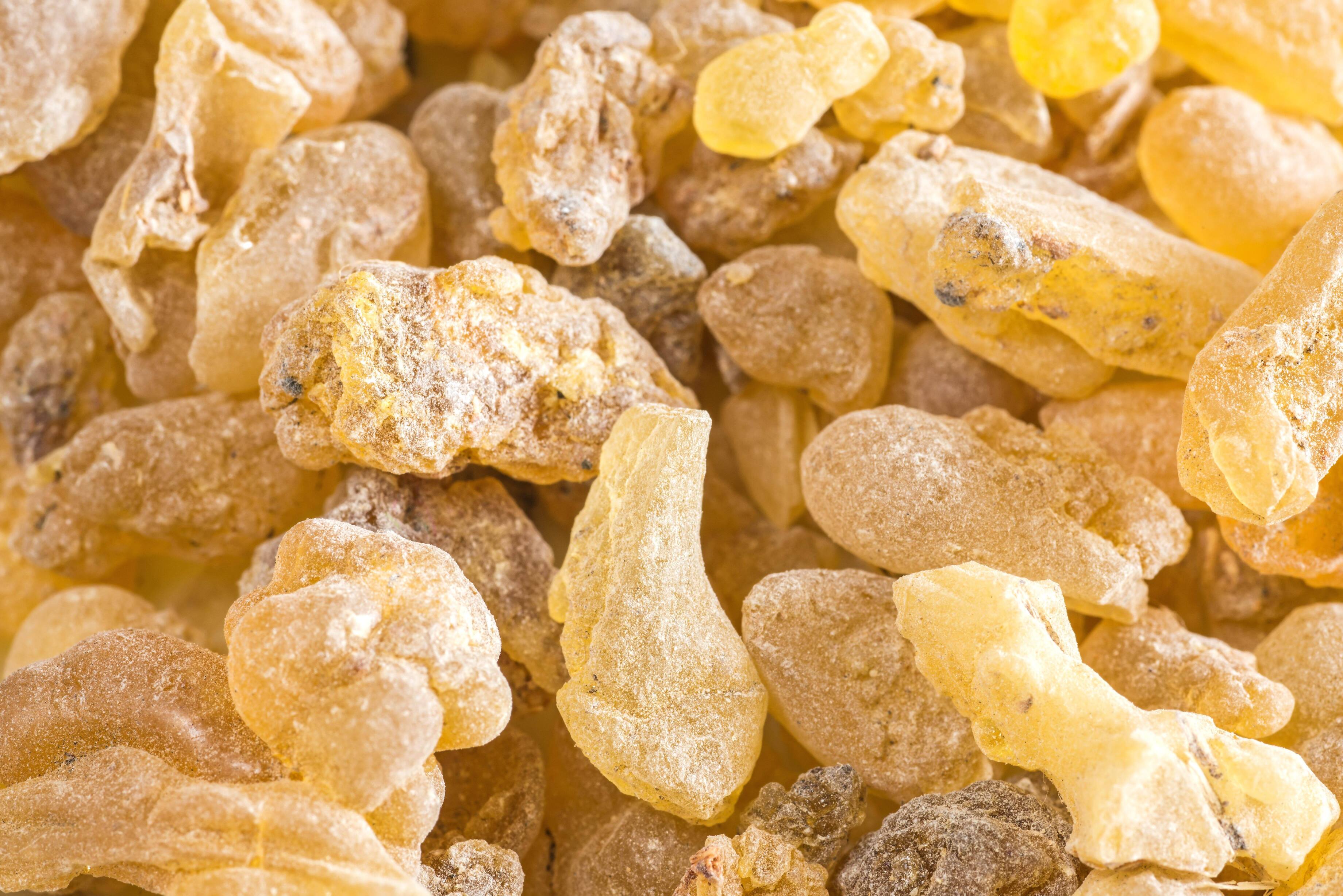
That the word comes from Mesopotamia matters, because Mesopotamia is where these aromatic materials arrived. They did not grow there. The Boswellia sacra tree, source of the finest frankincense, is native to the highlands of Dhofar in what is now southern Oman and to the valley systems of Yemen. The terrain that produces it is arid and rocky, the soil thin, the conditions harsh enough that the tree has adapted to grow from bare rock faces. Archaeological evidence places frankincense harvesting and trade between Dhofar and the southern reaches of Mesopotamia as early as the Neolithic period. By the second millennium BCE the trade had become one of the most consequential commercial networks in the ancient world.
The route it followed was not a single road. It was a system. Overland, caravans moved northward from the Dhofar highlands and the valleys of Yemen through the Arabian interior, stopping at oases and fortified stations, taxed at each transition by the kingdoms that controlled the territory. The foundational producers were the South Arabian kingdoms: the Sabaeans, Qatabanians, and Hadhramautians, who monopolised the harvesting and early-stage control of frankincense and myrrh, developing state institutions and irrigation systems to manage production and secure transit from mountain valleys to regional outlets. Their capital cities sat at the intersections of caravan routes: Marib, capital of Saba; Shabwa, capital of Hadramawt, positioned at the crossroads of routes connecting the interior valleys to the northern passes. From these cities the caravans moved toward Najran, then Yathrib, the city that would become Medina, then Petra, then Gaza, where goods dispersed into the Mediterranean and Levantine markets.
The domestication of the camel made this possible at scale. Its domestication around 1500 to 1200 BCE allowed the incense trade to grow: the animal was capable of carrying heavy loads of resin across the extreme conditions of the Arabian interior, progressing from oasis to oasis. Before the camel, the crossing of the Arabian Peninsula was a logistical problem without a solution. Afterward it was merely difficult. By 1000 BCE frankincense was known and valued in Babylon, Egypt, and across the Fertile Crescent.
The maritime route ran parallel. From the ports of Dhofar, dhows loaded with resin moved along the Indian Ocean coastline, driven by the monsoon winds that made the crossing to India and back predictable and seasonal. The port of Sumhuram, at the lagoon of Khor Rori on the southern Omani coast, thrived as an international seaport for over 800 years, going back to the third century BCE, welcoming ships from civilisations including Mesopotamia, ancient Egypt, the Indus Valley, and the Mediterranean. The port was fortified. The resin was worth protecting.
What arrived in Mesopotamia through these routes was not only frankincense. The incense roads carried the full inventory of the ancient aromatic world. Saffron moved westward from Persia and the Iranian plateau. Cinnamon and cardamom arrived from the Indian subcontinent through the maritime network. Myrrh came from the Horn of Africa alongside the Somali frankincense. Oud, or agarwood, originated in the forests of Assam and Southeast Asia and moved along the Indian Ocean routes through the same ports that handled the resin trade. These materials had been in each other's company for centuries before any perfumer combined them. The incense road did not merely transport goods. It assembled the vocabulary of an entire aromatic tradition.
These materials had commercial grades. The Akkadian term nisqu was one of the words that marked that distinction. What it reflects is the recognition that aromatic materials are not uniform. A frankincense harvested from an old tree in the right season from the right wound on the bark is not the same material as the resin scraped from a younger tree in the wrong conditions. The grading was not arbitrary. It reflected centuries of accumulated knowledge about which materials, from which sources, under which conditions, were worth the distance they had travelled.
The city of Kufa was founded in 638 CE, six years after the Prophet's death, on the western bank of the Euphrates in what is now southern Iraq. It was one of the first great Islamic garrison cities, established to house the Muslim armies that had moved into Mesopotamia and to serve as an administrative centre for the new territories. The land it was built on had been inhabited continuously for thousands of years. Below Kufa lay the sediment of Babylonian and Assyrian civilisation. The cuneiform tablets that recorded the aromatic grades of the ancient world, including the word nisqu, were pressed into clay on the same ground.
The script that emerged from Kufa is the oldest systematised Arabic calligraphic form. It was not named Kufic because it was invented there. The angular, geometric Arabic letterforms it systematised had developed across the region in the preceding centuries. It was named Kufic because Kufa was where it was standardised, where it became the form in which the Quran was first written down and transmitted.
That purpose shaped the script entirely. The earliest Kufic manuscripts were not made for aesthetic display. They were made for permanence and legibility in the service of preservation. The letterforms are angular because angular forms survive. They can be carved into stone, stamped into coin, woven into textile, pressed into clay. Rounded, cursive scripts, the scripts that came later, are faster to write and more beautiful at smaller scales, but they do not survive the same range of surfaces. Kufic was designed for a world in which writing needed to outlast the person who wrote it.
The absence of diacritical dots in the earliest Kufic manuscripts is also significant. In classical Arabic, dots are necessary to distinguish between letters that share the same basic form: the same stroke or curve serves multiple letters, differentiated only by the placement of marks above or below. In the earliest Quranic manuscripts, those marks do not appear. The script was written for readers who already knew the language and could read the consonantal skeleton without additional signs. With the expansion of Islam into other regions, the dots were gradually added to make reading accessible to communities for whom Arabic was not a native tongue. The marks that are now inseparable from Arabic script were originally concessions to new audiences.
This transformation within the very logic of writing shows that the path is not merely a historical sequence. The logic of selection, evaluation, and transmission continued across centuries: from material to writing, and from writing into new forms of expression. The same precision once applied to assessing the quality of frankincense in Mesopotamia reappears, in another form, within later systems of writing; as if each era develops its own language for recording what has been chosen. It is within this continuity that a contemporary reading also finds its meaning.
In engaging with these historical and linguistic layers, the work with early Kufic script for the Nisqu perfume was entrusted to Khatera Naderi: someone tasked not with a modern or decorative version of the script, but with reconstructing its original, rigorous form. To arrive at this, she turned to the earliest available Kufic manuscripts and, under the guidance of her mentor, reinterpreted the structure of the letters from those foundational sources. She produced more than 150 pages of handwriting practice using a reed pen before approaching the final composition. After a period of sustained trial, the structure settled into stability in both her mind and hand; a point where proportions, spacing, and the weight of the strokes reached a unified balance. In one of the final stages, in the silence of the work, the arrangement of the letters revealed itself to her, as if the form had always existed and only needed to be seen.
She wrote Nisqu as a unified whole, using the simplest and most original forms of diacritical dotting derived from the earliest manuscripts: marks added in the period before any standardised notation system had been established.
The line that begins with the Akkadian graders in ancient Babylon, continues to the Muslim scribes in Kufa, and reaches Khatera in the present is not merely a metaphor. It is a geographical continuum. The same land, the same river, the same layers of accumulated civilisations, each receiving what those before it carried and transmitting it forward in a new form.
Nisqu is the name of what remains unchanged throughout this entire path: the quality of attention given to aromatic materials, and the sign that indicates when that attention has reached its sufficient measure.


تعليق واحد
I started my evening writing down a few notes about the late Tapputi of Mesopotamia, only to find myself diving into another insightful historical lesson through your articles. Once again, the team has done an exceptional job delivering something both informative and deeply constructive.
What truly stands out is how these historical details elevate perfume creation beyond mere artistry; they transform it into a historical and cultural footprint. Perfumery, in this sense, becomes not only an olfactory craft, but also a vessel carrying fragments of ancient civilizations through time.
As part of my humble feedback and outreach, I genuinely believe these valuable hidden intentions and narratives deserve to be included within the packaging itself. This way, anyone purchasing the fragrance would realize they are not merely acquiring a scent, but an olfactory artwork intertwined with an ancient historical legacy.
I would also strongly encourage preserving and printing these writings physically, rather than keeping them solely as binary data in the digital realm. Centuries from now, such texts may very well become references, scripts, or historical testimonies for future generations studying the evolution of scent, culture, and memory.
Islam.
Mohamed Islam Chorfi
اترك تعليقًا
This site is protected by hCaptcha and the hCaptcha Privacy Policy and Terms of Service apply.